


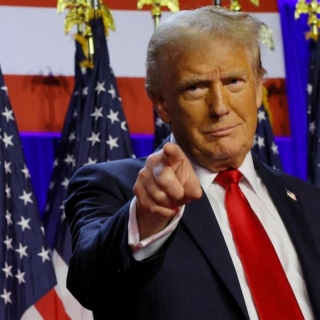
U.S. President Donald Trump on Thursday continued to take aim at the European Union for what he claims is an unequal trade relationship.
"From the standpoint of America, the EU treats us very, very unfairly, very badly," Trump said in a virtual address to the World Economic Forum in Davos, Switzerland.
After his inauguration on Monday, Trump's second term has been a key topic of conversation at Davos this year — particularly given his threats of trade tariffs on the EU, China, Mexico, Canada and beyond.
Echoing previous comments, Trump said in his Davos address: "They make it very difficult to bring products into Europe, and yet they expect to be selling and they do sell their products in the United States. So we have, you know, hundreds of billions of dollars of deficits with the EU, and nobody's happy with it. And we're going to do something about it."
"They essentially don't take our farm products and they don't take our cars, yet they send cars to us by the millions. They put tariffs on things that we want to do ... We have some very big complaints with the EU," he continued.
Trump in December said the EU would face "tariffs all the way" unless it increased its purchases of U.S. oil and gas, something European officials have expressed a willingness to do.
He added on Thursday: "They want to be able to compete better, and you can't compete when you can't go through the approval process faster. There's no reason why it can't go faster ... I'm trying to be constructive, because I love Europe."
The U.S. is the biggest recipient of EU goods, accounting for nearly a fifth of the bloc's exports. The U.S.′ biggest trade deficit with the EU is in machinery and vehicles, with a gap totaling 102 billion euros ($106 billion) in 2023. In energy, Washington had a trade surplus with the European bloc worth 70 billion euros; it also has a significant trade surplus in services.
European Central Bank President Christine Lagarde told CNBC earlier this week at Davos that the EU must "be prepared" for the imposition of U.S. tariffs under Trump. She also said the fact that he had not immediately imposed sweeping tariffs was a "very smart approach ... because blanket tariffs are not necessarily giving you the results that you expect."
Spanish Prime Minister Pedro Sanchez, meanwhile, told CNBC that a trade war was not in the interests of the European Union or the U.S., calling the countries' economies "very interlinked."(Cay) Newsmaker23
Source: CNBC
Tested EN...
Asian stock markets weakened for the second consecutive day, indicating that the initial rally that had been "speedy" at the start of the year is starting to lose steam. At the same time, US governmen...
US stocks were mixed on Wednesday as investors weighed uneven economic data against expectations for eventual Federal Reserve easing, with the S&P 500 easing 0.2% and the Dow Jones sliding 0.8% fr...
European stocks were in mixed territory on Wednesday morning, as regional market jitters grow over U.S. President Donald Trump's threat to annex Greenland. The pan-European Stoxx 600 was little chang...
Asian stock markets weakened slightly on Wednesday after posting their best start to the year in history. The decline was driven by a decline in Japanese stocks amid escalating tensions with China. Th...
Oil prices stabilized on Thursday (February 12th), as the market reassigned a risk premium to US-Iran tensions despite US inventory data showing swelling domestic supplies. This movement confirms one thing: geopolitical headlines are still more...
Gold prices weakened slightly on Thursday (February 12th), as more solid US employment data reduced market confidence in an imminent Federal Reserve interest rate cut. The strong employment data prompted market participants to shift expectations of...
The Hang Seng Index reversed its downward trend in Hong Kong on Thursday (February 12th), weakening by around 0.9% to around 27,000 after a strong session earlier. This decline halted the momentum of the short term rally, as investors began to...